
Pay for the capability you need.
Compare cost per call alongside the results. See where a smaller model fits and where a more capable one is worth its price.
OSPP MODEL ARENA
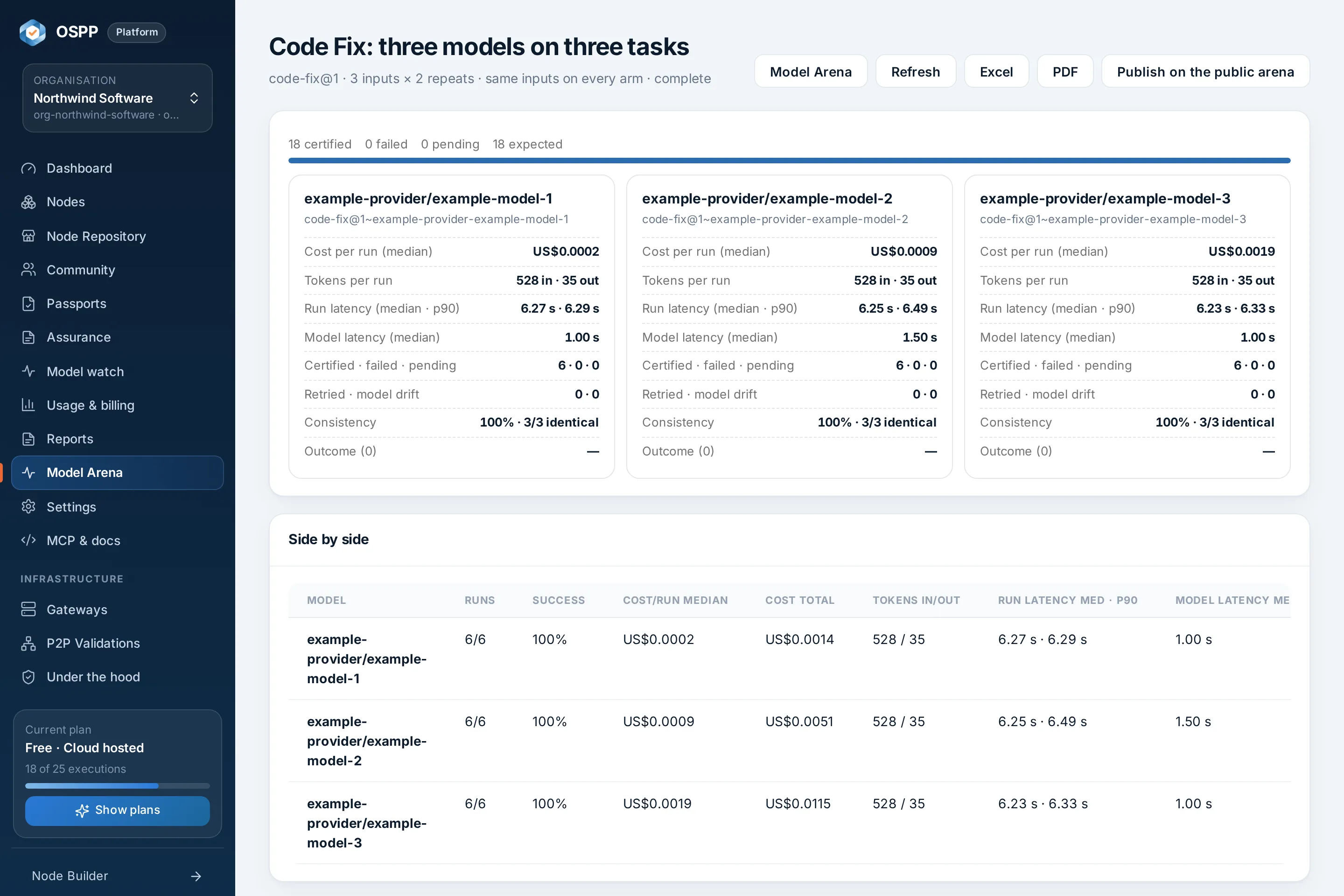
A leaderboard does not know your task. Model Arena runs your real past calls again on other models and puts cost, speed, reliability and outcome side by side, so you pay only for the capability your task needs. The decision is yours; you change the model in your own code.
The same six past calls · run again on each model
Compare the price of the same calls, rather than a model’s headline price.
The arena describes each model on the same calls. Which trade-off matters is your decision.

Illustrative figures, not a live benchmark or model ranking.
A BETTER BASIS FOR CHOOSING
The question is not which model is best in general. It is how each model does on the calls your application really makes, and what each of those calls costs you.
Compare cost per call alongside the results. See where a smaller model fits and where a more capable one is worth its price.
Post a score or a count to the outcome address of a call. The arena shows the outcomes your own systems reported, model by model.
Follow a comparison back to its passports. Keep the record behind a model choice, and compare again when your task or the models change.
THE WHOLE PICTURE
No single score tells the whole story. Read the trade-offs together.
Tokens, cost per call and total spend at the prices recorded in each passport.
Median and p90 duration of a call, plus the model’s own response time.
Certified, failed and pending calls, retries and reported model drift.
Check how often repeated inputs return byte-identical answers.
What your systems reported against each passport: a score, a count, or your own metrics.
See whether models return the same majority answer for an input.
Consistency and agreement measure repeatability, not correctness. Neither says an answer is right. Outcomes are what your systems reported; they do not prove that the model caused the result.
HOW A COMPARISON IS MADE
Off, the conversation and the answer of a call are deleted shortly after the answer was delivered, within about an hour; the fingerprints and the passport stay. On, the conversation and answer of the node's later calls are kept encrypted for the node's retention period (30 days by default, 1 to 365). The node's definition, system prompt included, is kept either way. A single call can opt out with X-OSPP-Store: false.
On the Platform, run any kept call again on another model. The re-run gets its own passport, linked to the original, which never changes. A selection of 1 to 50 passports of one node version, run on up to 8 models, is a Model Arena comparison. Re-runs are billed as normal calls and stay out of the node's production figures.
model value in your own code.ON THE PLATFORM
Open Model Arena on the Platform. Inspect the individual passports behind each figure and export a comparison as Excel, PDF or JSON.
START WITH ONE NODE
Switch Model Compare on for one task today. It is not retroactive: only calls made after the switch can be run again.
Organisations that publish a comparison put it here with its passports. Publishing is the organisation's choice, and it can be withdrawn.