
Every AI call on the record: OSPP in healthcare
Medicine already runs on the rule that what is not documented did not happen. AI is the first tool in the clinic that mostly escapes that rule. A passport for every AI call, validated by independent peers, brings it back inside.
Every clinician learns the same sentence early: if it is not documented, it did not happen. The medication, the dose, the time, the person who gave it and the person who checked it all go into the record, because care is a chain of people relying on what the last one wrote down.
AI is now in that chain. It drafts the consultation note from a recording. It summarises three hundred pages of history before a clinic. It writes the first version of a discharge letter, a referral, a reply to a patient message, a prior authorisation request. The output is filed. What produced it usually is not: which model, in which version, told to do what, and whether it is still the same model that the hospital tested in the spring.
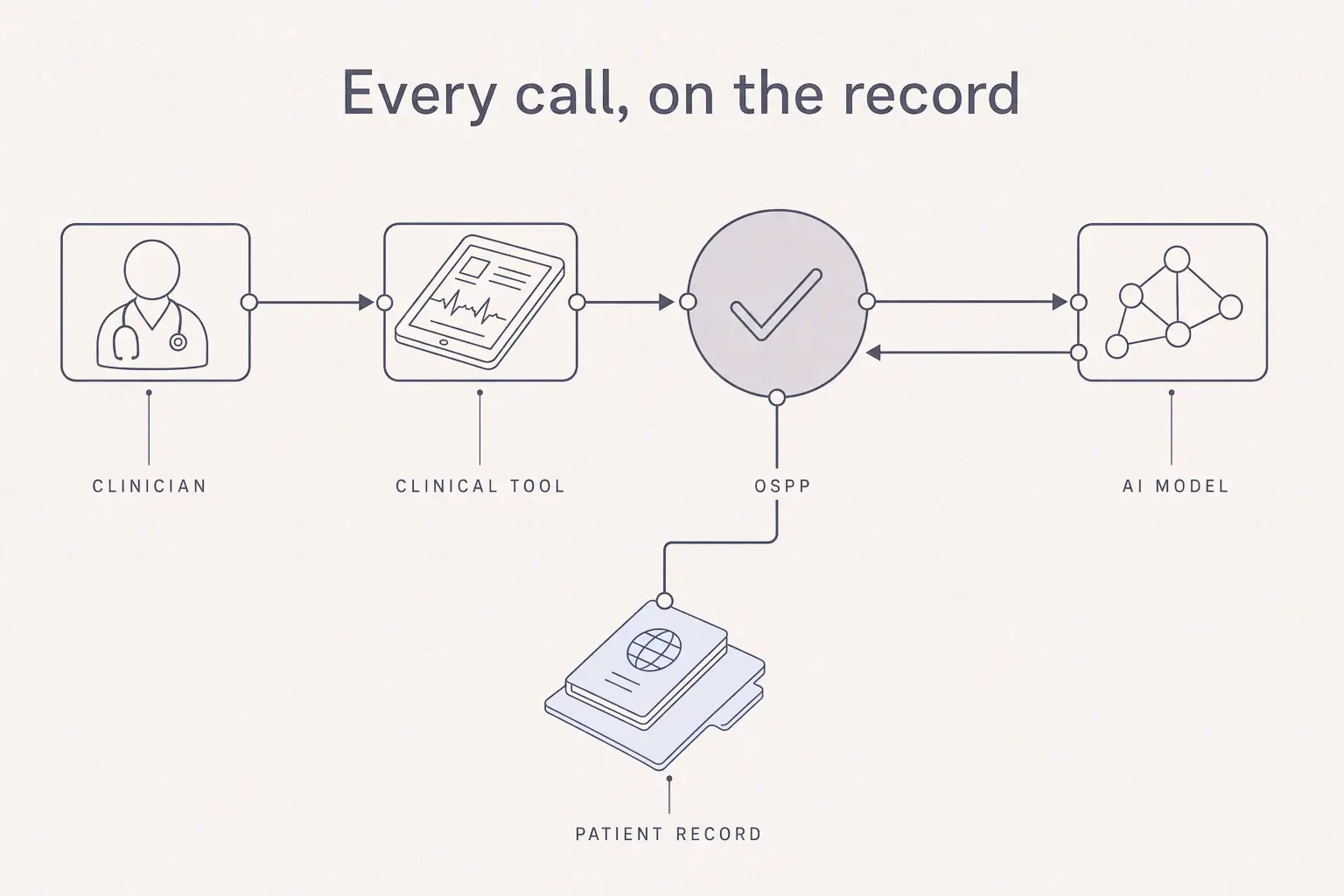
OSPP brings that part back onto the record. Every AI call gets a passport: a small signed record of which model was called, for which task, when, and with which fingerprints of the request and the answer. The passport id can sit beside the note in the patient record, and anyone it is shown to can verify it.
How it fits into a hospital or practice#
Clinical AI tools, bought or built, almost all reach a model through the same kind of connection, the OpenAI chat API. OSPP is one endpoint that speaks that API. The tool keeps its prompts and its model; only the address it calls changes. From then on, each answer returns with its passport.
Two labels make the record usable.
- The task. A tool names what it is doing, for example
consultation-note-draftordischarge-letter. OSPP calls this a node. One set of instructions, parameters and model is one version of the task, so a changed prompt shows up as a new version. - Your reference. A call can carry the organisation's own identifier, such as an encounter or document id, and passports can be found by it. It is a reference, never a place for a patient's name.
A second pair of eyes on every record#
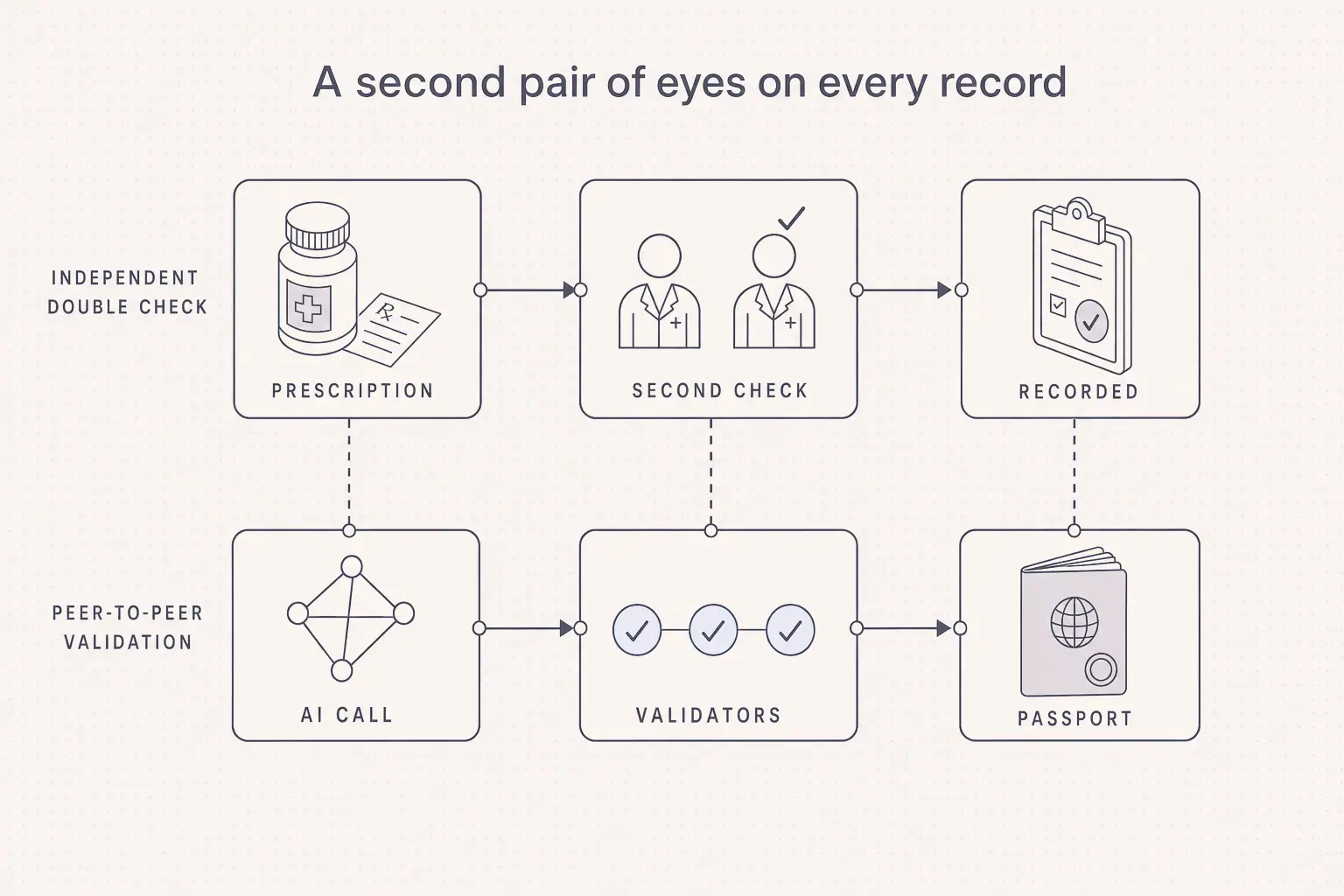
Healthcare does not trust a single signature where the stakes are high. A high-risk medication is checked by a second nurse who did not prepare it. A consent form is witnessed. The principle is old and simple: the person who did something is not the one who confirms it was done.
OSPP applies that principle to the record of every AI call, and calls it peer-to-peer validation. Every organisation on OSPP has a validator. Before a passport is issued, validators that did not make the call check the record of it: that the request was logged before the model answered and the answer after, that nothing in the log was removed, reordered or rewritten, and that the entries follow the published rules. Then they cosign. Without those cosignatures no passport is issued, and a call with an open finding is held until it is resolved.
Three things about this matter in a clinical setting.
- The validators never see patient data. They see fingerprints of the request and the answer, never the text. A consultation is witnessed without being read by anyone outside the care team.
- Nobody confirms their own entry. The hospital cannot validate its own calls alone, and neither can OSPP. That is what makes a record hard to alter afterwards for anyone, including the vendor of the tool, the hospital and OSPP itself.
- The witnesses are accountable. A validator that cosigns a faulty record, or misses a planted test, earns a strike and is suspended after three. Who the witnesses are, and which party runs each, is public. A hospital with a self-hosted installation runs its own validator on its own server and becomes one of the peers.
The second nurse checks the dose. The validators check something narrower: that the record of the call is genuine. Whether the draft note is clinically right stays where it belongs, with the clinician who reads and signs it. OSPP is not a medical device and does not assess an answer.
Where it helps#
1. Patient data: checked at the door, kept in the building#
Health data is the most protected category there is. Before a call leaves for a model, the gateway checks what is being sent: personal data, identity numbers, secrets, and the special categories under the GDPR, health and genetic data among them. The organisation sets a policy per task. A finding is flagged, masked (on OSPP Cloud) or blocks the call. A scheduling assistant that should never see a diagnosis can be set to block; a note-drafting task that must see clinical content is set differently. The result is recorded as counts, never as text, which is the kind of evidence a data protection officer can work with.
For most providers the stronger answer is where the call runs.
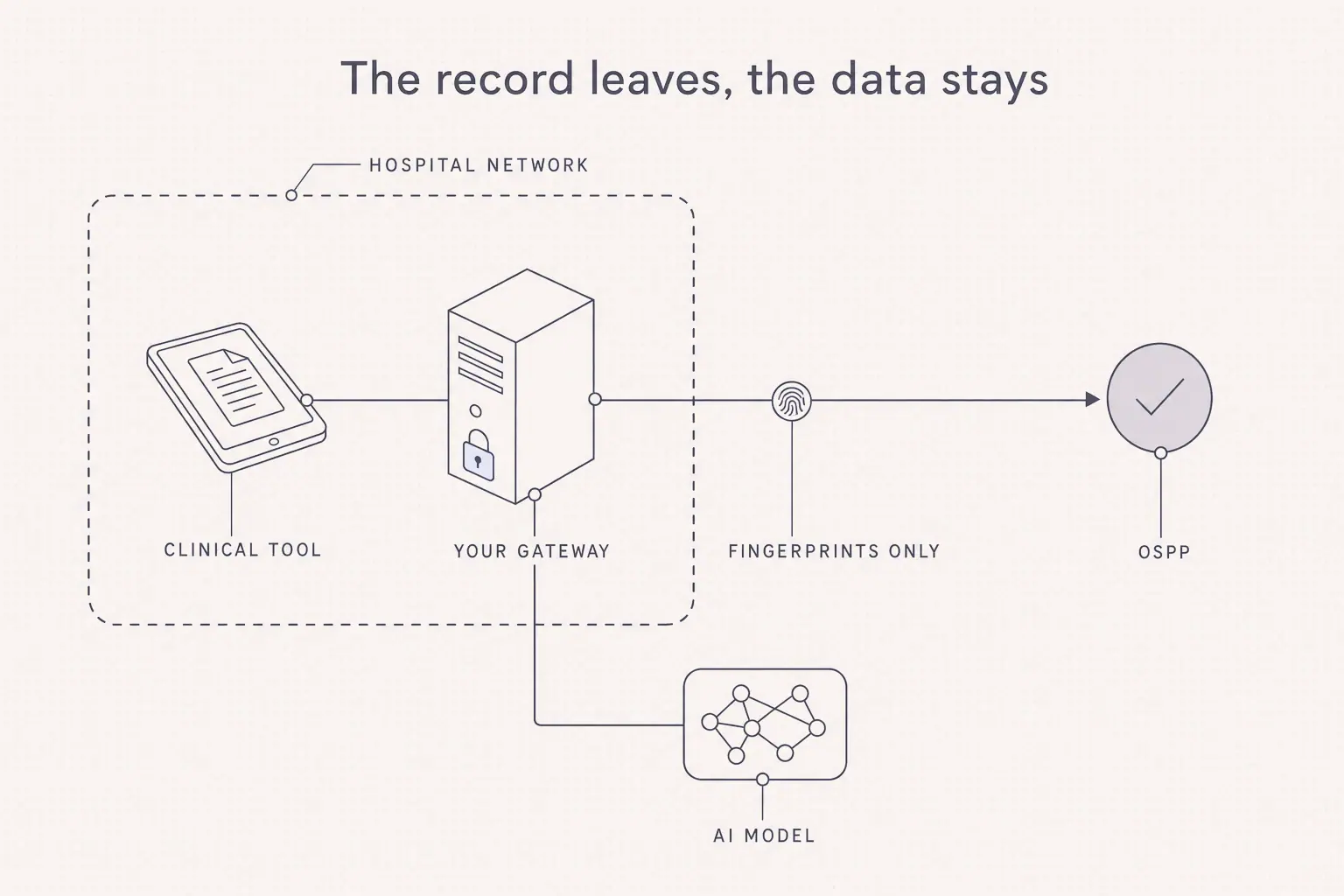
With a self-hosted gateway, on an ordinary server inside the organisation's own network and with its own provider keys, the conversation and the answer never reach OSPP in readable form. OSPP sees fingerprints and figures and issues the passport. The model provider the organisation chose still receives the request, exactly as it would without OSPP; that contract and that choice stay with the organisation. One thing does reach OSPP in every case: the task's definition, including its system prompt. Instructions go there. Patient information goes in the conversation.
2. Clinical documentation: which draft came from where#
Ambient scribes and note assistants are the most widely adopted AI in clinics. When a note is questioned months later, by a colleague, a patient or a reviewer, the first questions are factual: was this passage drafted by AI, by which tool and model, and when? With the passport id stored beside the note, the answer takes a minute. If the organisation kept the draft, its fingerprint either matches the passport or it does not, which also shows what the clinician changed before signing.
3. Still the model you validated?#
A hospital tests an AI tool before it lets it near patients. The test is done on a model in a certain state. Providers then update models under an unchanged name.
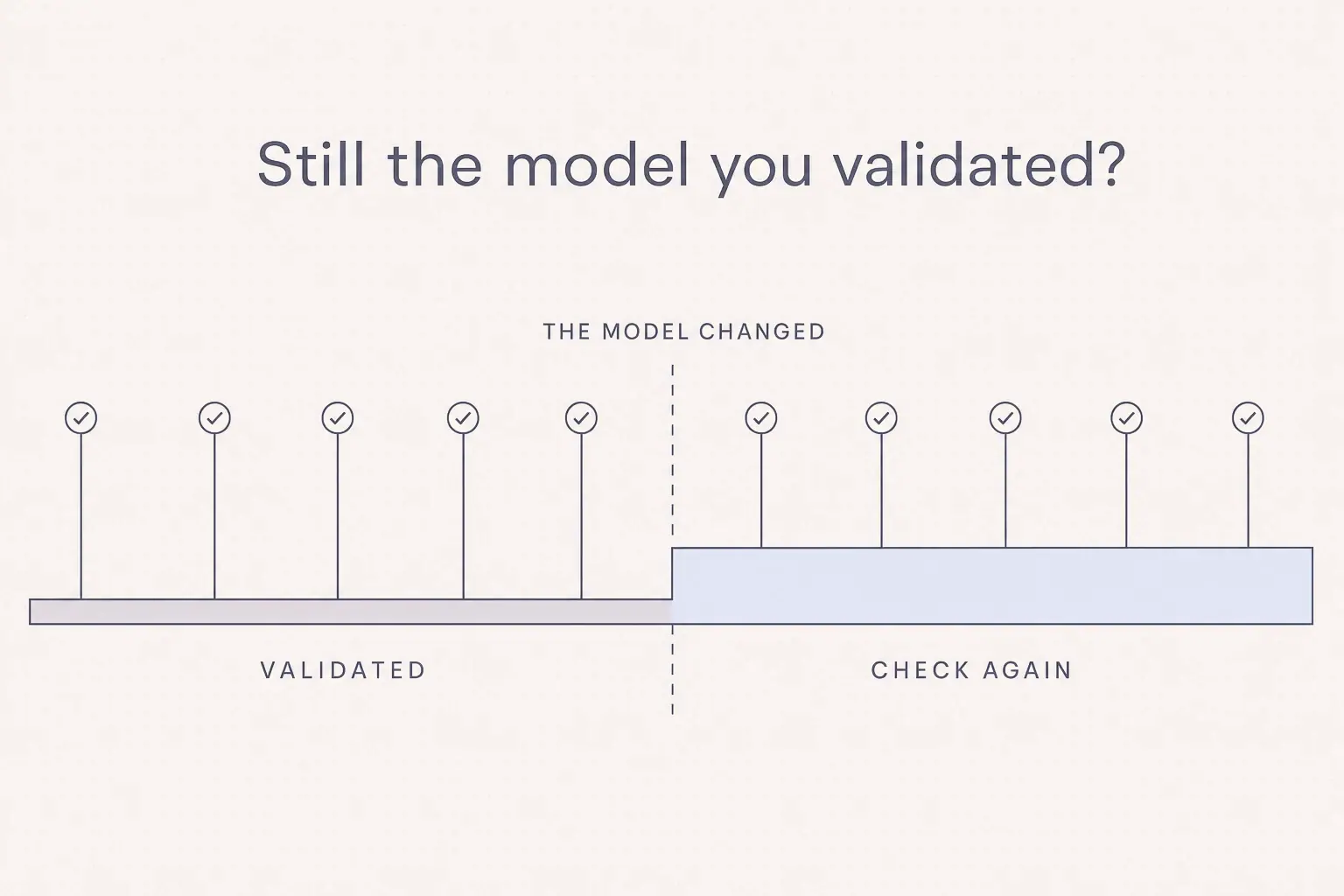
Model watch probes every model in use with a fixed set of questions that have determinate answers. A confirmed change in the answers opens a new epoch, the organisation is notified, and the epoch is stamped on every passport. The clinical safety team then knows the date from which its validation no longer describes the model in use, and which notes were drafted before and after. A replay runs a past call again on the same input and reports whether the answer is identical, slightly different or changed.
4. Messages to patients and the front door#
Portals and practices increasingly use AI to draft replies to patient messages and to answer questions about appointments, preparation and results. When a patient says "the assistant told me to stop taking it", today the organisation can rarely show what was said.
With a passport on each answer there is a record that the call happened and when, and, where the answers of that task are kept, the text itself. Sometimes the record will show a misunderstanding. Sometimes it will show the assistant was wrong, and then the organisation knows quickly, before the same answer goes to the next patient.
5. Decisions about a person#
Some AI calls feed decisions that affect an individual: a triage priority, a prior authorisation, an eligibility check. A subject decision receipt gives that person a page showing which task ran, when, on which model, the parts of the answer the organisation chooses to disclose, and the passport to verify it. It does not contain the prompt. It answers the question patients are entitled to ask, what did the system contribute and who decided, without the organisation having to reconstruct it.
Records like these support the documentation duties that come with high-risk AI under the EU AI Act. They do not replace a conformity assessment, and they do not make a tool a certified one.
6. Coding, claims and letters to payers#
Clinical coding, claim preparation and authorisation letters are high-volume, rule-bound and audited, which makes them early candidates for AI and early targets for questions. Each document processed has a passport naming the version of the task, so an organisation can show that claim forty thousand was prepared under the same instructions as claim one. Where the team reports an outcome against each passport, such as accepted on first submission, the Finance statement gives the cost per accepted claim, with the passport ids behind every line.
7. When something goes wrong#
In an incident review, the worst position is not knowing. With every call recorded, the review can establish which calls contributed to a document, in what order and with which model, and can place a legal hold (part of the Compliance add-on) on the passports involved so that content still held is not deleted while the review runs. Passports and their log entries are never deleted, and each was cosigned by validators outside the organisation at the time, so the timeline cannot be tidied afterwards.
8. Buying clinical AI#
Hospitals buy far more AI than they build, and every vendor says its product is safe, private and controlled. A vendor that runs its product through OSPP can hand over a passport with each result, and the hospital can verify up to two hundred at a time, without an account: that the calls exist, when they were made, with which model, by which operator, and that none has been withdrawn. An assurance profile puts a task's track record into one document for procurement, an auditor or an insurer.
9. Research and quality improvement#
The same records serve the research side of a teaching hospital. A study that used a language model to extract data from records can archive its passports with the dataset and hand reviewers an evidence pack whose hash OSPP registers. The post on research labs covers this in depth.
10. Choosing and budgeting models#
For tasks where the organisation chooses to keep call content, the Model Arena runs its own past calls again on other models and puts cost, speed, reliability and consistency side by side. It names no winner and does not judge the answers; clinicians do that. On a self-hosted installation the content stays on the organisation's gateway and calls are run again there. Either way, "can this task move to a smaller model?" becomes a measured comparison on the organisation's own cases.
Starting with one task#
Pick a task with low clinical risk and a clear owner, such as drafting referral letters in one department. Point the tool at OSPP, name the task, send the document id as the reference, and store the passport id beside the letter. Then read the first passports together with the clinical lead, the data protection officer and the person responsible for clinical safety.
The free plan covers 25 executions with every feature switched on and no card. The quick start takes about five minutes. Organisations that keep patient data inside their own network run the same endpoint on a self-hosted gateway. The trust model describes peer-to-peer validation in full, and the security page describes the data check.