
A lab notebook for AI calls: OSPP in research labs
A language model in a research pipeline is an instrument, and instruments need a notebook and a calibration record. A passport for every AI call gives a lab both, validated by peers in a way that mirrors peer review, and verifiable by reviewers years later.
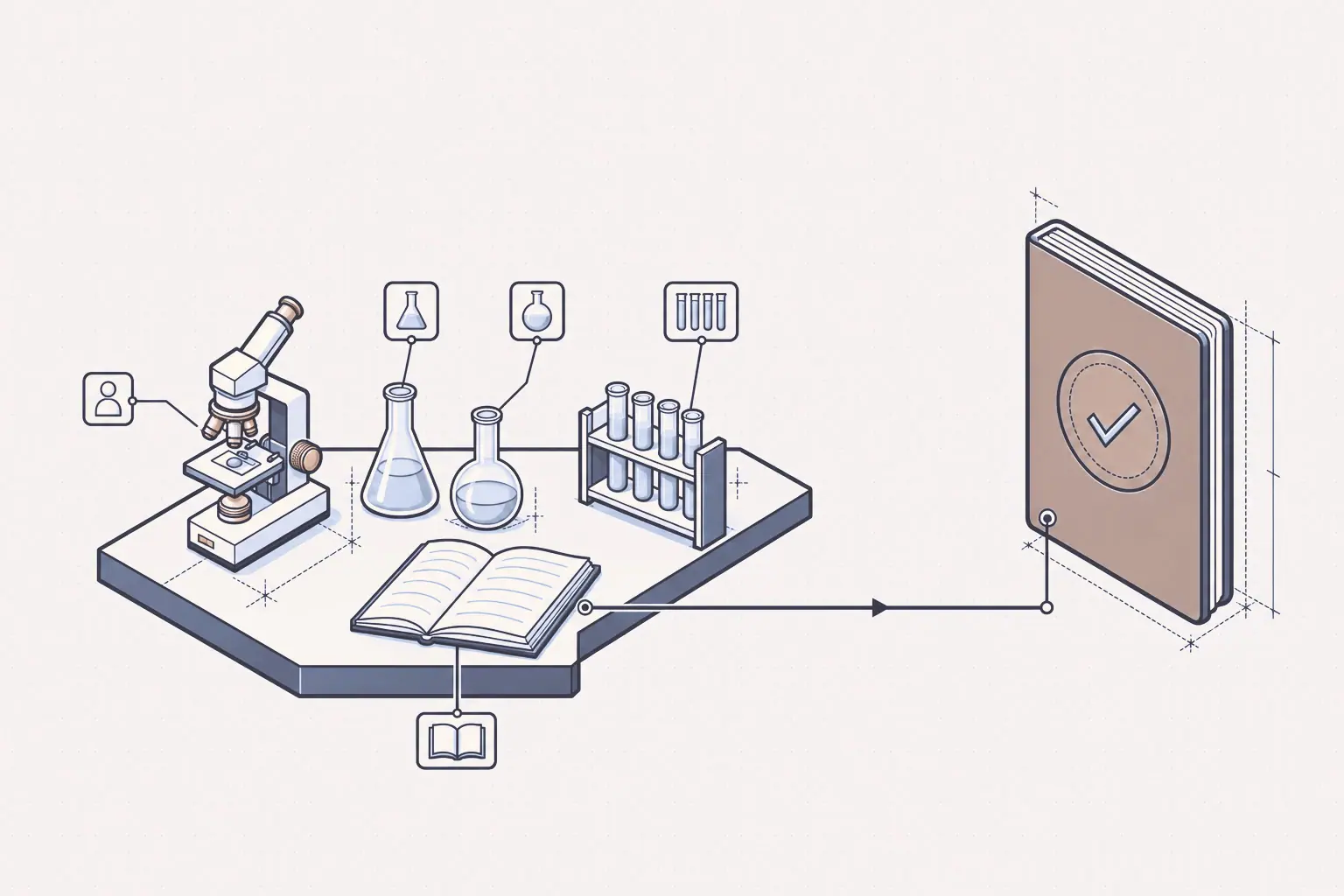
Every laboratory runs on two habits. You write down what you did, at the time you did it, in a notebook nobody can quietly rewrite. And you know the state of your instruments: when the balance was calibrated, which lot the reagent came from, which firmware the sequencer ran.
Language models have entered research as instruments. They label images and code interviews, extract values from thousands of papers, draft analysis scripts, generate synthetic data and drive agents that plan experiments. And for this one instrument, most labs keep neither habit. The prompt lives in a script that has since been edited. The model is recorded as a name that the provider may have changed underneath. The answers sit in a spreadsheet with no way to show they are the ones the model gave.
The methods section then says "we used a large language model", and a reviewer is asked to take it on trust.
OSPP gives every AI call a passport: a small signed record of which model was called, for which step, when, and with which fingerprints of the request and the answer. It is the notebook entry and the calibration sticker for an AI call, and anyone can verify it.
How it fits into a lab#
Research code nearly always reaches a model through the OpenAI chat API, directly or through a library. OSPP is one endpoint that speaks that API. The script keeps its prompts and its model; only the base URL changes. Every answer then returns with its passport.
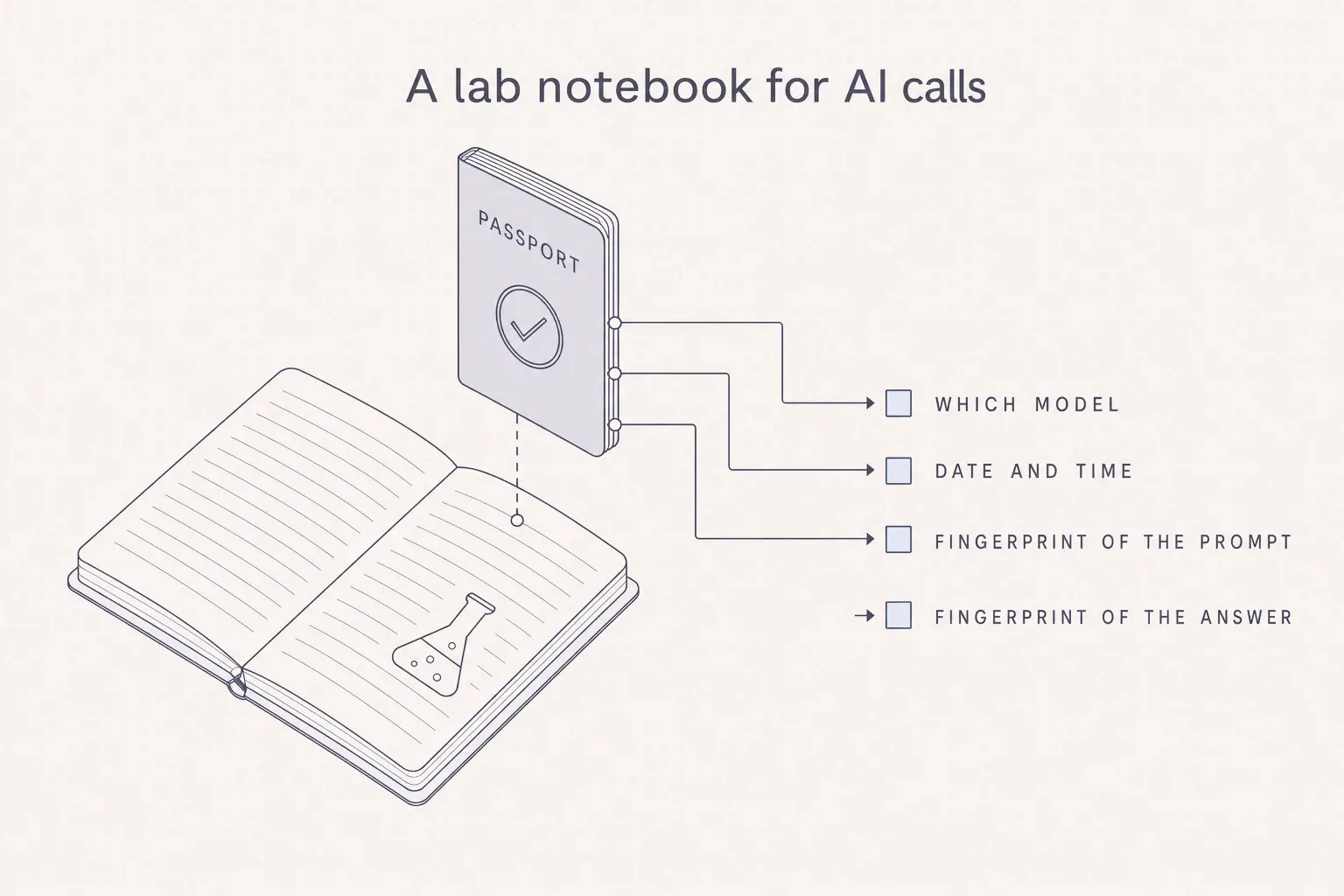
Three labels turn a pile of passports into a record of an experiment.
- The step. A script names what it is doing, for example
abstract-screeningortranscript-coding. OSPP calls this a node. One set of instructions, parameters and model is one version of that step, so a changed prompt is visible as a new version, not buried in a commit. - The run. All calls of one pipeline run or one agent task can share a trace id, so the forty round trips of an agent are found together.
- Your reference. A call can carry the lab's own identifier, such as an experiment or sample-batch id, and passports can be searched by it.
Peer review for the record itself#
A notebook entry counts for more when someone else has countersigned it. Science built an entire institution on that idea: in peer review, work enters the literature only after people who did not do it have examined it.
OSPP applies the same principle to the record of an AI call and calls it peer-to-peer validation. Every organisation on OSPP has a validator. Before a passport is issued, validators that did not make the call check the record: that the request was logged before the model answered and the answer after, that the log has only grown and nothing in it was removed, reordered or rewritten, and that every entry follows the published rules. Then they cosign. A record without those cosignatures never becomes a passport, and a call with an open finding is held until the finding is resolved.
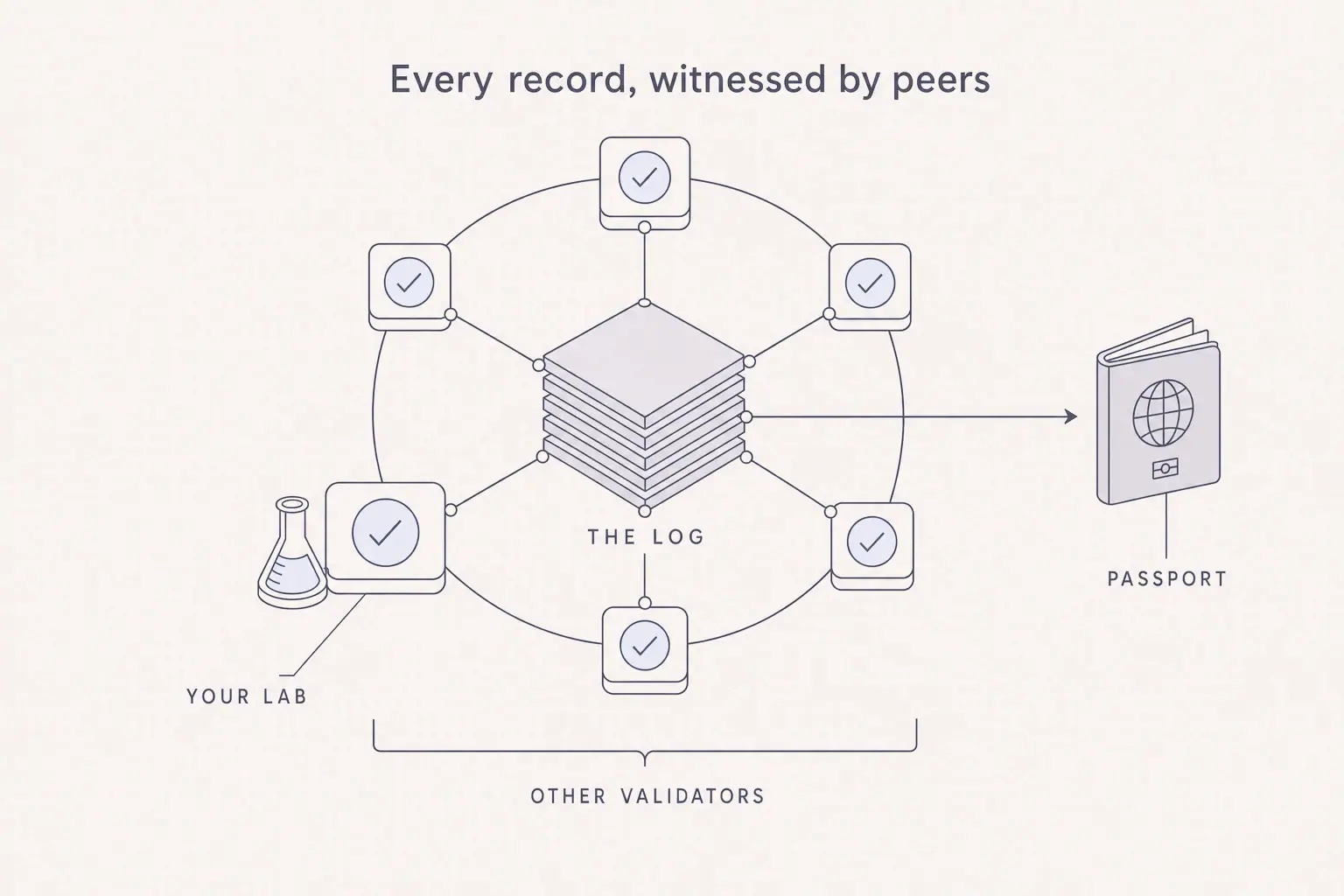
Researchers will recognise most of this.
- Independent of the author. A lab cannot validate its own calls alone, and OSPP cannot either. That is what makes the record hard to alter afterwards for anyone.
- Peers, not a central authority. Every participant has a validator, hosted by OSPP by default. A lab or institute with a self-hosted installation runs its own, on its own server, and takes part in validating the network. Independence grows with every party that does.
- Reviewers with a track record. Validators are scored on accuracy, uptime and speed. One that cosigns a faulty proof, or misses a planted test record, earns a strike and is suspended after three. Who the witnesses are, and which party runs each, is public.
- Blind by construction. Validators see fingerprints, never a prompt or an answer. Unpublished data and participant records are witnessed without being disclosed to anyone.
- Open methods. The rules a validator applies are published, and two independent reference verifiers must agree on every test case.
The difference from peer review is the question being asked. A reviewer judges the science: is the method sound, do the conclusions follow? A validator judges the record: did this call happen as stated, in this order, and is it unchanged? One takes months and expertise; the other takes seconds and arithmetic. A paper built on AI calls needs both. Peer-to-peer validation gives the human reviewers something solid to review.
What it does for the science#
1. A methods section that can be checked#
A set of passports answers what a methods section has always had to answer: which instrument, in which state, applied how. Each one names the exact model, the version of the step, and the time, and fixes the fingerprints of what was asked and what came back. Each was validated by peers before it was issued, so a reviewer is not asked to take the lab's word, or OSPP's. If the lab archives its prompts and answers with the dataset, anyone can later confirm that these are the texts of those calls: the fingerprints match, or they do not.
The passport files can be verified offline, with an open reference verifier in Python or TypeScript and no help from OSPP. That matters for a record meant to outlive a grant, a postdoc and possibly a vendor.
2. Knowing when the instrument changed#
Providers update models under an unchanged name. For a lab that is the equivalent of a balance recalibrating itself overnight without telling anyone.
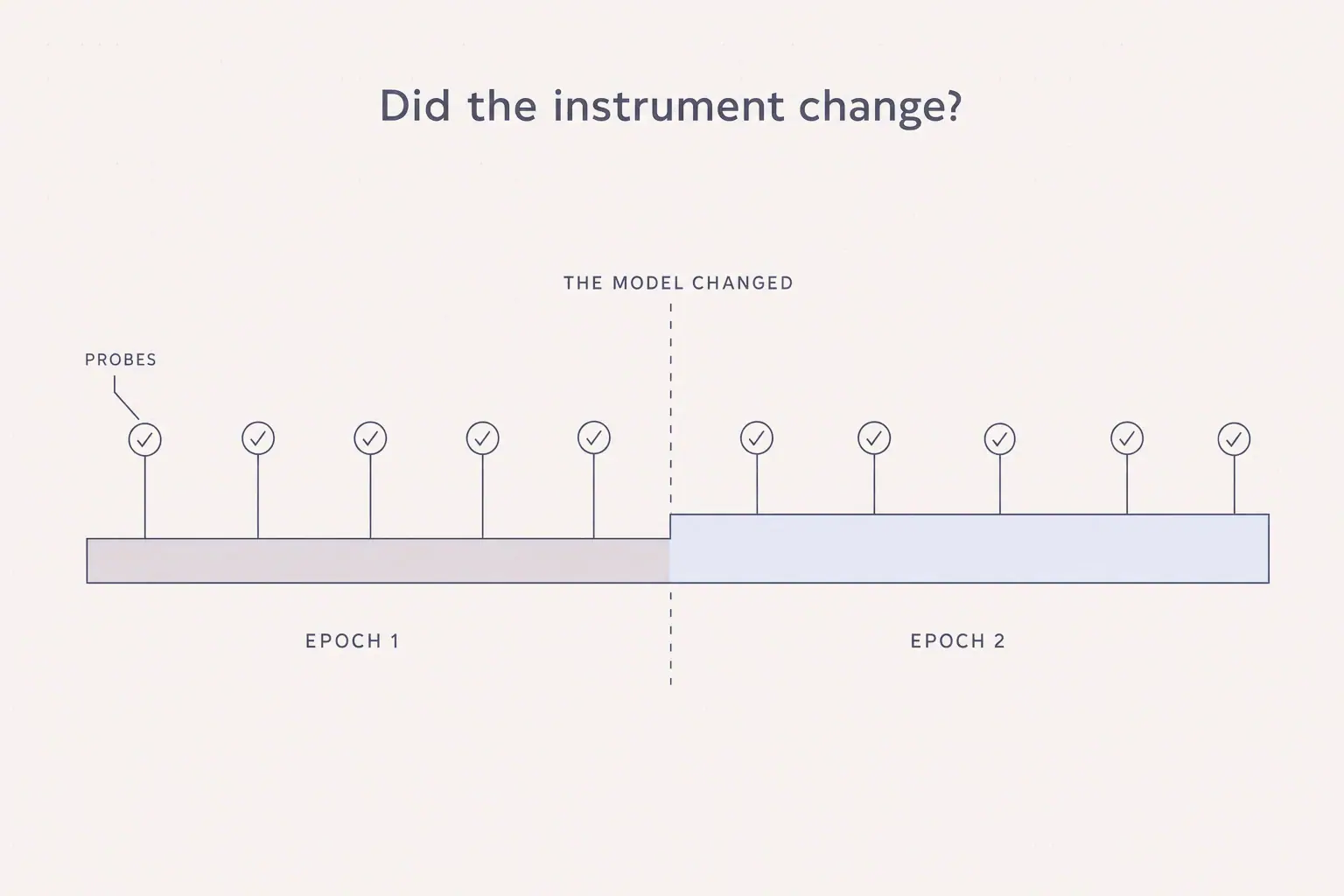
Model watch probes each model a lab uses with a fixed set of short questions that have determinate answers. As long as the answers stay the same, the model is in the same epoch. A confirmed change opens a new one, the lab is notified, and the current epoch is stamped on every passport. Every probe is itself a call with a passport, so the evidence for a change is public, not a vendor's assurance.
For a study that runs for months, that is the difference between "we used model X" and "calls 1 to 4,200 were made in epoch 3 and the rest in epoch 4, and here is the sensitivity analysis".
3. Replication, and measuring the instrument's noise#
A replay runs the call of a passport again on the same prompt and compares the two answers: identical, the same apart from case and spacing, or changed, with a similarity score and a diff. The replay gets its own passport, which names the one it replays. A lab can replay a sample of its calls before submission, or a year later, and report what it found.
Models are also noisy instruments, and the noise can be measured. The Model Arena runs a selection of a step's past calls again, up to five times each, on up to eight models. Per model it reports how often repeats of the same call gave the same answer, beside cost, speed and reliability. That is a consistency figure for the instrument on your task. It compares fingerprints, so it says whether answers were the same, not whether they were right; the lab's own gold standard answers that, and can be reported against each passport as an outcome.
Both need the lab to have kept the content of its calls, which is a switch per step and off by default. A lab that expects to replicate should switch it on when the study starts; it is not retroactive.
4. Agents and pipelines: every round trip on record#
When an agent plans, calls tools and revises, a single task is dozens of model calls. With OSPP each round trip is a call with its own passport, grouped by the trace. A reader can see the order of events as it was recorded at the time, and the record cannot be tidied up afterwards. For anyone who has tried to reconstruct from logs why an agent did what it did, that is a relief in itself.
5. Participant and patient data#
Much research data is about people. Before a call leaves for a model, OSPP's gateway checks what is being sent for personal data, identity numbers, secrets and the special categories the GDPR protects most, such as health and genetic data. The lab sets a policy per step: flag a finding, mask it (on OSPP Cloud) or block the call. The passport carries the result as counts, never as text, which is the kind of evidence an ethics board or a data protection officer can use.
For data that must not leave the institution, the same endpoint runs on a self-hosted gateway on an ordinary server. The conversation and the answer then never reach OSPP in readable form; OSPP sees fingerprints and figures. On OSPP Cloud, call content is deleted within about an hour by default, and a single call can be marked not to be kept even for a step where keeping is switched on. One thing is always kept: the step's definition, including the system prompt. Instructions go there; data goes in the conversation.
6. From the bench to the reviewer#
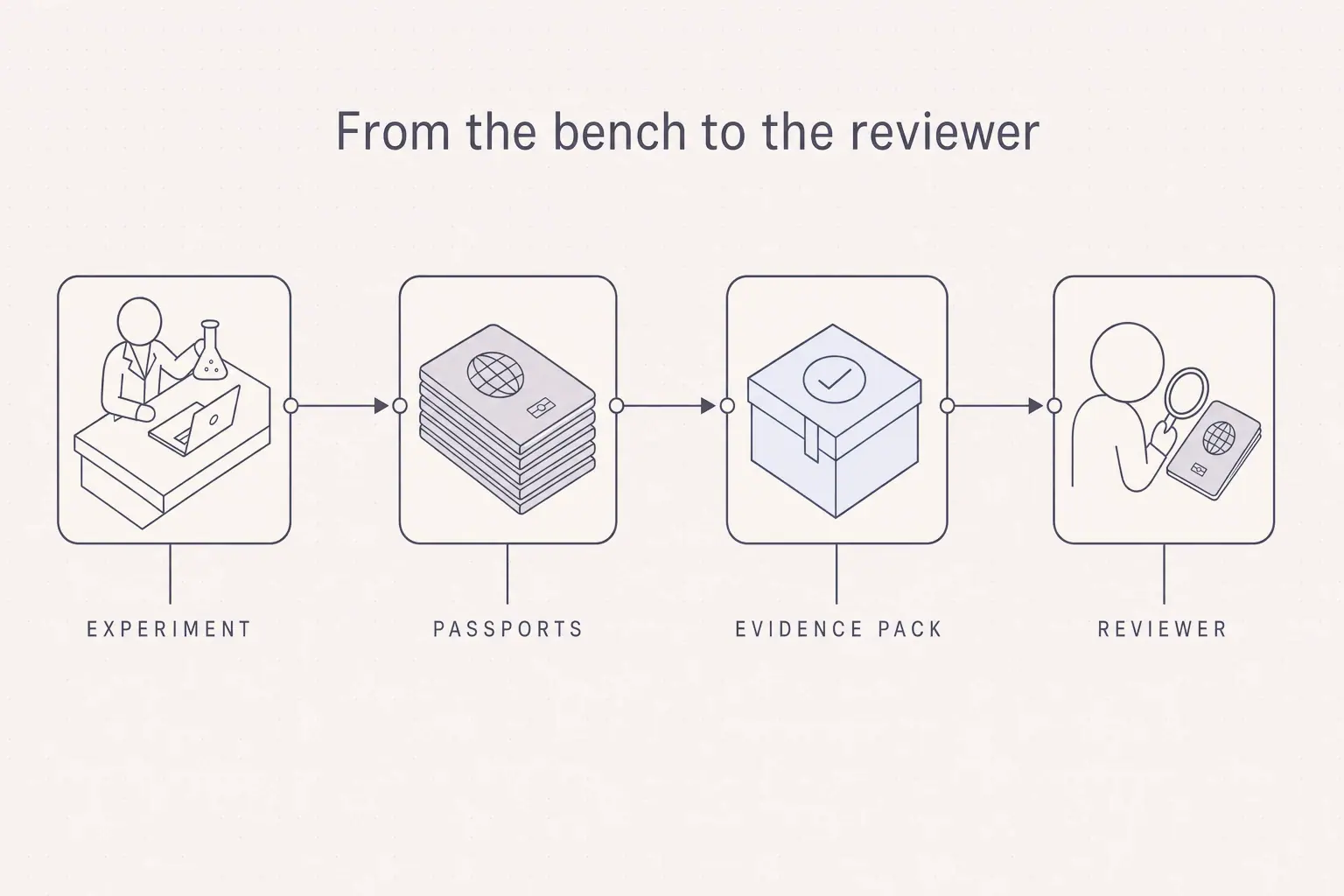
For a submission, the lab has two things to hand over.
An AI use statement covers the disclosure that journals and funders now ask for: one page listing the AI calls behind a manuscript, each with its passport and a note on what it contributed, and the people who reviewed the result. It has a fixed hash once issued.
An evidence pack, part of the Compliance add-on, bundles the passports of a period or of one step, up to 5,000 with their offline proofs, into a single file. OSPP registers the file's hash, so a reviewer or an archive holding a copy can confirm, without an account, that it is the original.
7. Benchmarks other labs can verify#
Labs publish model comparisons all the time, and readers have to trust the table. A comparison made in the Model Arena can be published: it then appears with its figures and the ids of its passports, which anyone can verify. The public view shows whether the models agreed, not what they answered, so a lab can publish a verifiable comparison without publishing its data.
8. Shared facilities and grant budgets#
A core facility or a principal investigator has to account for what was spent and on what. The Finance statement lists, per step and per month, the model cost as measured on each passport, with the passport ids behind every line. Where a lab reports outcomes, such as the number of records correctly extracted, the statement also gives the cost per outcome. A lab that uses its own provider keys pays the provider directly for model use.
9. Labs with an audit trail to keep#
Some labs work under quality systems that expect a trail of what was done, when, and by which system, and expect that trail to resist later editing. Passports and their log entries are never deleted, and peer-to-peer validation means every entry was cosigned by validators outside the lab, so a record cannot be altered without the alteration showing. Whether that meets a particular standard is for the lab's quality unit to judge. The raw material it will ask for is there.
Starting with one experiment#
Pick one pipeline that is still running, change its base URL, name its steps, and send a run id as the trace. If replication matters, switch on content keeping for those steps on day one. Then open a passport with the person who will write the methods section and decide together what goes into the paper.
The free plan covers 25 executions with every feature switched on and no card. The quick start takes about five minutes. Model watch and the Model Arena are described in the documentation, labs that keep data in-house can run a self-hosted gateway, and the trust model describes peer-to-peer validation in full.