
AI on campus, with a record: OSPP in schools and universities
Education has spent three years trying to guess where AI was used. A passport for every AI call replaces the guess with a record that is validated by peers, much as a paper is peer reviewed, and that students, teachers and examiners can each check for themselves.
Ask a teacher what worries them about AI and you rarely hear "that students use it". You hear "that I cannot tell". Ask a student and you hear the mirror image: "that I cannot show what I did". Ask a registrar, a research dean or a head of IT, and the sentence changes only slightly: we use AI in more places every term, and we could not reconstruct any of it if someone asked.
For three years the answer on offer has been detection: software that reads a text and estimates whether a machine wrote it. Detection is a guess, and a guess is a poor foundation for a grade, an appeal or a degree.
OSPP starts from the other end. It does not try to recognise AI after the fact. It gives every AI call a passport at the moment it is made: a small, signed record of which model was called, for which task, when, and with which fingerprints of the prompt and the answer. Anyone holding a passport can verify it, without an account and without asking the school.
This post walks through what that makes possible in a school or a university, and why the way a passport is checked will feel familiar to anyone who has been through peer review.
How it fits into a campus#
Most institutions already have, or are choosing, their own AI tools: a writing assistant inside the learning platform, a tutor bot for first-year mathematics, a help desk that answers enrolment questions, scripts in a research group. Nearly all of them talk to a model through the same kind of connection, the OpenAI chat API.
OSPP is one endpoint that speaks that API. The tool keeps its prompts, its model and its code; only the address it calls changes. From then on, each answer comes back with its passport.
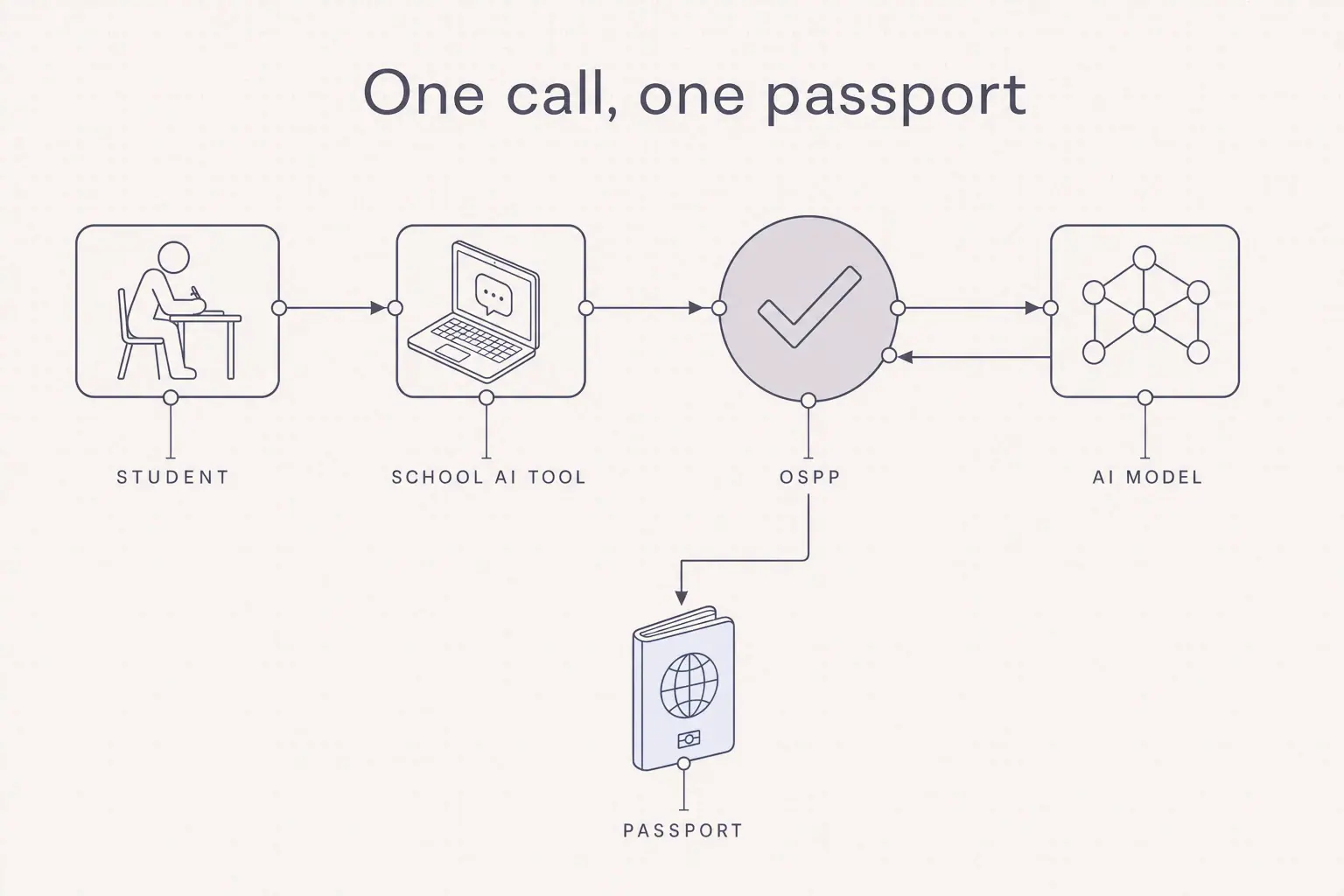
Three details matter for education in particular.
- The task has a name. A tool labels its calls, for example
essay-feedback-year-10oradmissions-summary. OSPP calls this a node, and it is how a school later finds, counts and compares the calls of one activity. - Sensitive data is checked before it leaves. Every call passes a data check for personal data, identity numbers, secrets and the special categories the GDPR protects most, such as health. A school's policy decides per task whether a finding is flagged, masked (on OSPP Cloud) or blocks the call. That matters when the people typing are minors, and when a support plan or a medical note can end up in a prompt.
- The conversation need not leave the building. With a self-hosted gateway on an ordinary server, the conversation and the answer never reach OSPP in readable form. OSPP sees fingerprints and figures; the content stays with the school.
Checked by peers: the part academics will recognise#
Why would anyone believe a record that OSPP hands out about calls that OSPP carried? For the same reason nobody believes a paper just because its author says it is sound. Academia solved that problem long ago with peer review: before work enters the record, people who did not write it look at it, and a journal publishes only when they are satisfied.
A passport goes through the same kind of gate, and OSPP calls it peer-to-peer validation. Every organisation on OSPP has a validator. Before a passport is issued, validators that did not make the call check the record of it: that the request was logged before the model answered and the answer after, that nothing in the log was removed, reordered or rewritten, and that the entries follow the published rules. Only then do they cosign, and only a cosigned record becomes a passport. If a validator raises a finding, the call is held, the way a manuscript waits when a reviewer objects.
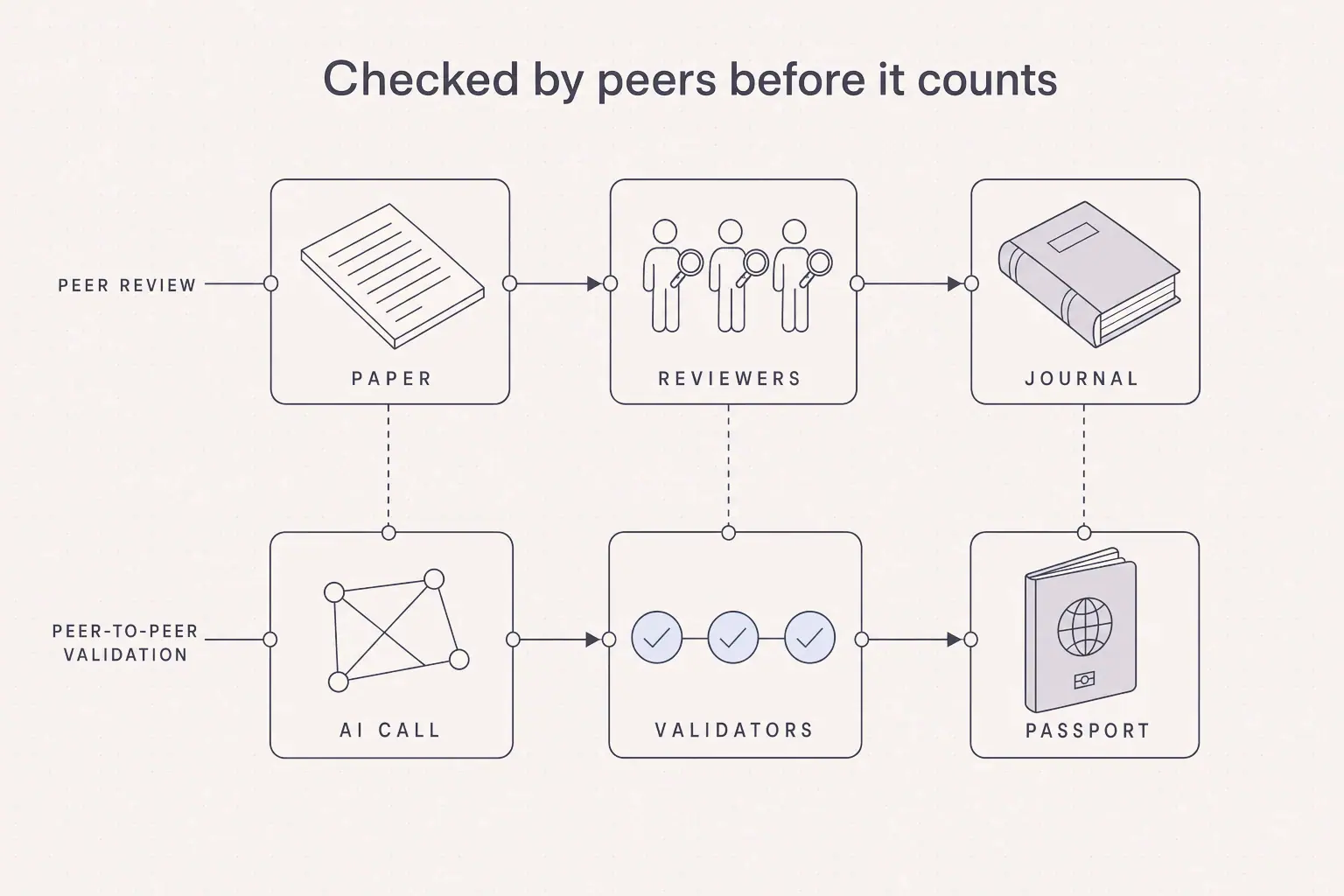
The parallels go further than the shape.
- Nobody marks their own homework. The party that makes a call cannot certify it alone. Neither can OSPP: the cosignatures are what make a record hard to change afterwards for anyone, OSPP included.
- Reviewers are peers. In academia every author is also a reviewer. Here every participant has a validator, hosted by OSPP by default, and an institution with a self-hosted installation runs its own on its own server. The more universities and schools do, the more independent the network becomes.
- Reviewers are accountable. A validator that cosigns a faulty record, or misses a deliberately planted test, earns a strike, and after three it is suspended. The network's public page shows who the witnesses are and which party runs each.
- It is blind review, taken literally. Validators never see a prompt or an answer, only their fingerprints. A student's question to a tutor is witnessed without being read by anyone.
There is one difference, and it matters. A peer reviewer reads the work and judges whether it is sound. A validator judges whether the record is genuine: that this call really happened, then, with this model, and has not been touched since. Peer review answers "is this good science?" in months. Peer-to-peer validation answers "did this really happen as recorded?" in seconds. Education needs both, and has only ever had the first.
Where the record helps#
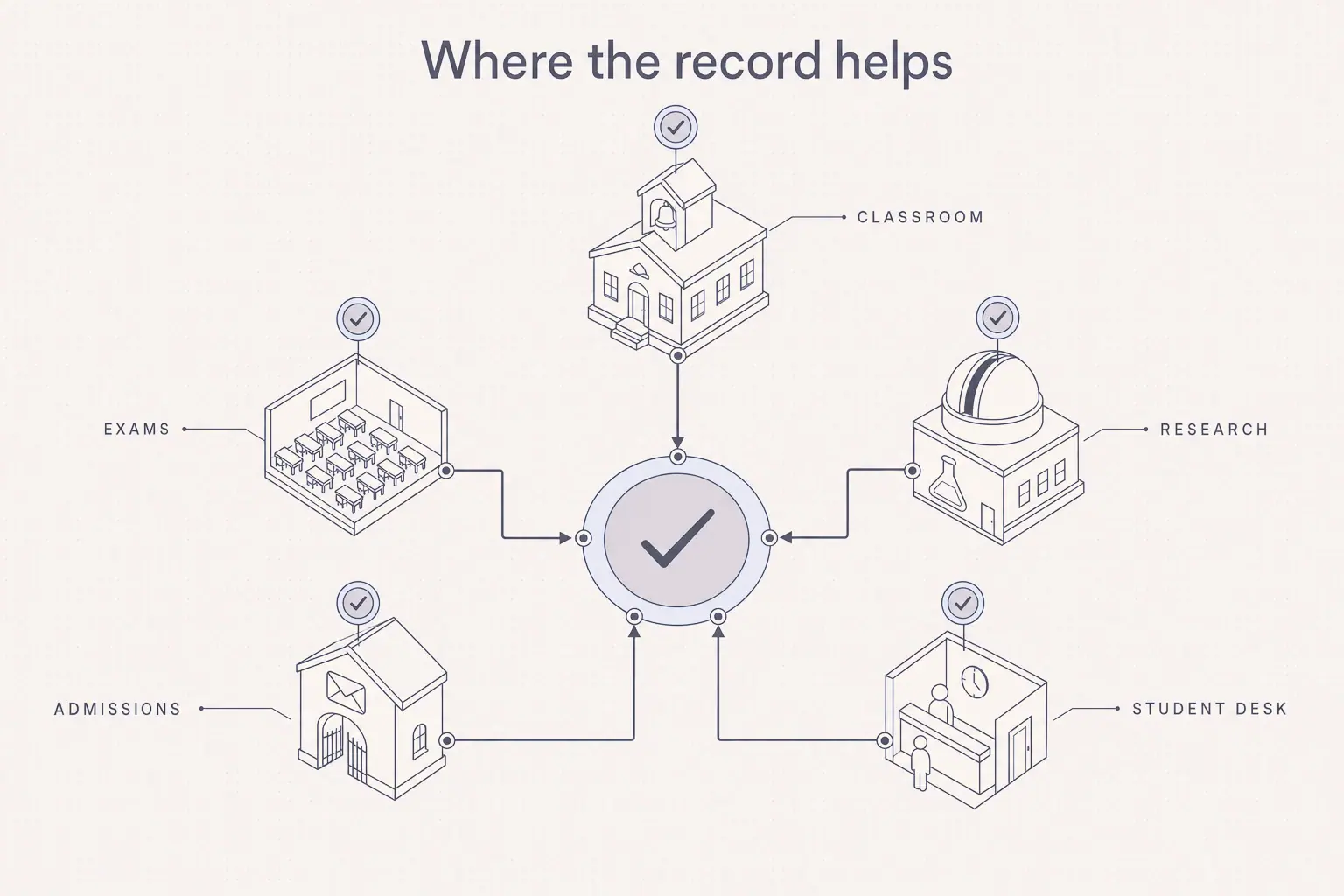
1. Coursework: show your working#
The most constructive AI policy a course can have is also the oldest rule in the classroom: show your working. Many institutions now allow AI for some steps (brainstorming, feedback on a draft, a language check) and ask students to declare it. The weak point is that a declaration is only a sentence at the bottom of an essay.
When students use the school's own assistant, each of their calls already has a passport. A course can then issue an AI use statement for a piece of work: the title, the passports of the calls behind it with a note on what each contributed, and who reviewed it. The statement can name the exact file by its fingerprint, computed in the browser, so the essay itself is never uploaded. The teacher opens one public page and can check every passport on it with one click.
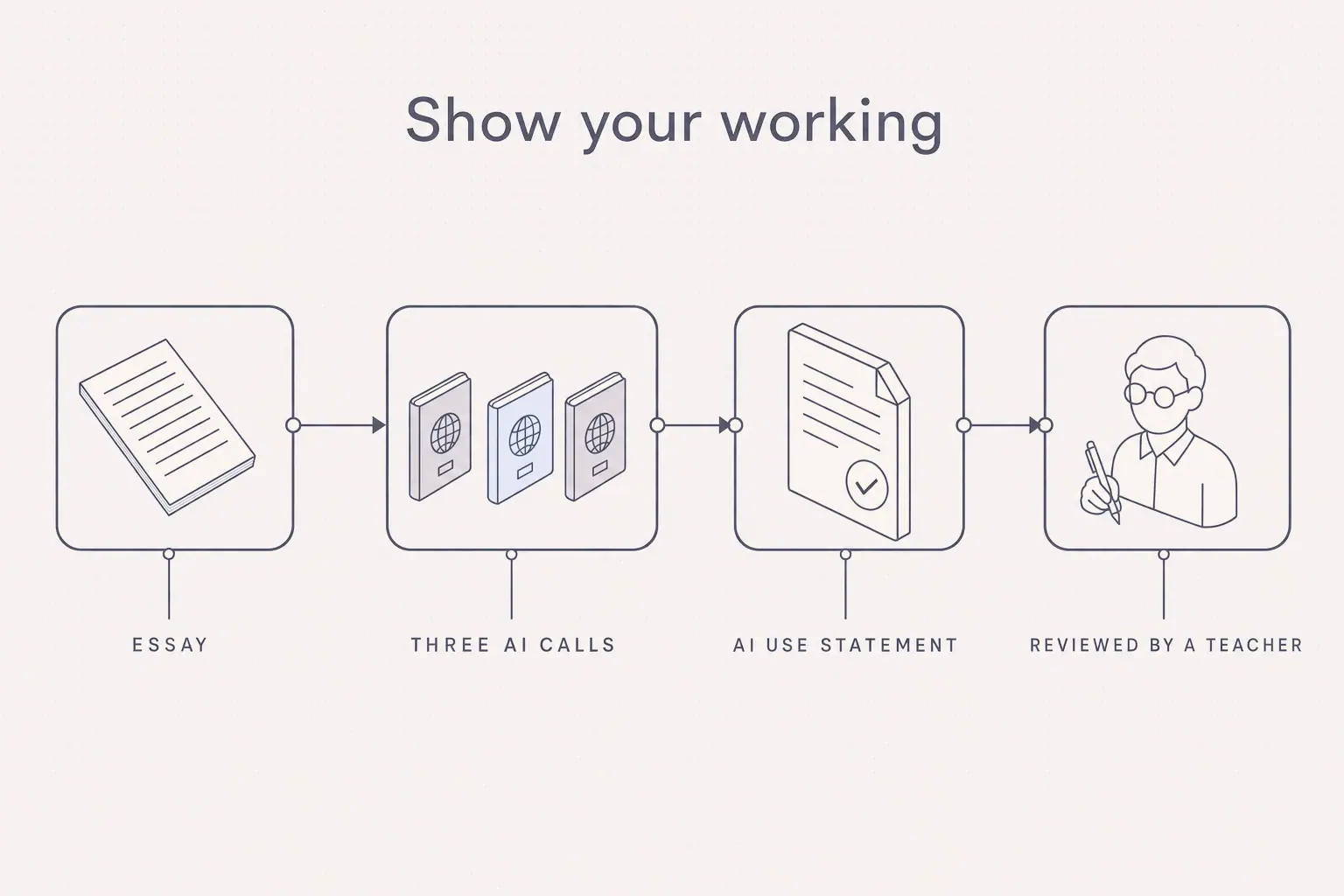
This changes the tone of the conversation. A student who used the assistant for feedback on structure can show exactly that: three calls, on these dates, to this tool. The teacher's question moves from "did you use AI?" to "tell me how you used it", which is the question worth asking.
2. Academic integrity: a dispute about facts, settled as one#
Integrity cases are painful partly because both sides argue from impressions. A passport adds two kinds of fact.
Time. A passport records when a call was made, and that moment was cosigned by validators other than the school's own before the passport existed. Neither the student nor the institution can move it afterwards. A student who says "I asked for feedback on my own second draft the evening before the deadline" has a record that says so, or does not.
Content. A passport holds fingerprints, not text. If a student kept the prompt and the answer, their fingerprints either match the passport or they do not. Nobody has to trust a screenshot.
A record like this protects honest students at least as much as it exposes dishonest ones. For anyone who has seen a detector flag a careful writer, that is the point.
3. Tutors and feedback bots: answer the parent's question#
When a school offers an AI tutor, parents and governors ask reasonable things. Which model are the children talking to? Has it changed since you tested it? What happens to what they type?
The passport names the model on every call, and OSPP never substitutes another. Model watch probes each model in use with a fixed set of questions and opens a new epoch when its behaviour changes, even if the provider kept the name the same; the epoch is stamped on every passport. And the data check gives a per-task picture of what kinds of sensitive data went towards a model, as counts, never as text.
For the teaching team, the same records answer a practical question: is the tutor helping? A tool can report an outcome against a passport, such as a thumbs-up from the student or a solved exercise. Over a term, the Platform shows cost, speed, errors and outcomes per task and per model.
4. Marking and feedback: a receipt for the student#
AI is moving into assessment: first-pass marking against a rubric, feedback on formative work, checking short answers. Under the EU AI Act, AI systems used to evaluate learning outcomes, to decide on admission, to assess the level of education someone should receive, or to monitor students during tests are classed as high-risk. Whatever the legal position of a particular tool, the student's question is fair: what did the machine say about my work, and who decided?
A subject decision receipt is the smallest honest answer. For a call that contributed to a decision about a person, the institution can hand that person a page showing which task ran, when, on which model, the parts of the answer the institution chose to disclose (the rubric scores, say, and not the internal prompt), and the passport to verify it. Because a receipt reads the stored answer, the marking task has to keep its answers, or the receipt is made right after the call.
The receipt does not say the mark is right. It says what the AI contributed, so that the human who signed off the grade can be asked about the rest. OSPP's records support that evidence work; they do not replace a conformity assessment.
5. Admissions and scholarships: the same judge for every applicant#
Suppose an admissions office uses a model to summarise personal statements for its readers. Two questions will come, in an appeal or an audit: was every applicant's file handled the same way, and can you show it?
Every summary has a passport naming the task version (the same instructions for every file) and the model. Model watch shows whether the model's behaviour changed between the first application and the last. If it did, a replay runs a past call again and reports whether the answer came out the same, each replay with a passport of its own. An office that needs to keep records through an appeal period can set a retention policy, and with the Compliance add-on place a legal hold on the passports of a single case.
6. Research: a methods section others can verify#
Researchers now use language models as instruments: to code interview transcripts, to screen thousands of abstracts, to extract data from documents. Reviewers then ask what a methods section has always had to answer. Which instrument, in which state, applied how?
"We used a large language model in March" does not answer it. A set of passports does. Each call names the exact model, carries the model's behaviour epoch, and fixes the fingerprint of what was asked and answered, all of it validated by peers before the passport was issued. The .ospp files can be archived with the dataset and verified offline by a reviewer years later, with an open reference verifier and no help from OSPP. If a model is retired or quietly changed, the record shows which results were produced before and after.
For theses and journal submissions, the same AI use statement that serves a classroom serves an author: one page, listing the calls behind the manuscript and the people who reviewed them.
7. The student desk: "the chatbot told me"#
Help desks for enrolment, housing and financial aid are where institutional chatbots are used most, and where a wrong answer costs a student most. When a student says the assistant gave them a different deadline, the institution today can rarely show what was said.
With a passport on each answer there is a record of the call, and if the answers of that task are kept, the institution can look at what the assistant said. Sometimes the record will show the student misread it. Sometimes it will show the student was right, and that is worth knowing quickly, before the next two hundred students get the same answer.
8. The IT office: one front door, and a budget that adds up#
A university does not have one AI tool. It has dozens, bought and built by faculties that do not talk to each other. Putting them behind one endpoint gives the institution a single place where data policy is applied and a single account of what is spent, per task and per model.
It also makes model choice an evidence question. The Model Arena runs a task's own past calls again on other models and puts cost, speed, reliability and consistency side by side. A tutor bot that handles ten thousand questions a week may run just as well on a model that costs a fraction. Twenty of your own students' real questions tell you more than a leaderboard.
9. Procurement: ask vendors for proof, not promises#
Schools buy far more AI than they build. Every education technology vendor says its AI is safe, private and under control. A vendor that runs its product through OSPP can hand the school a passport with each result, and the school can check up to two hundred of them at a time, without an account. It learns that the calls exist, when they were made, with which model and by which operator. That is a different footing for a contract than a paragraph in a brochure.
10. The lesson itself#
There is one more use, and it may be the one with the longest reach. A passport is a compact, real example of ideas every student should meet: what a fingerprint of a text is, what a signature proves, why an independent witness matters, and how peer-to-peer validation resembles the peer review their own teachers' papers go through. The Passport Validator and the specification are open. A class can make a call, download the file, change one character and watch verification fail. That is AI literacy you can hold in your hand.
Starting small#
Nobody needs a campus-wide programme to begin. Pick one tool where the question "what did it do?" already comes up: the writing assistant of one course, the admissions summariser, one research project. Change its base URL, give its task a name, and read the first passports together with the people who will rely on them.
The free plan covers 25 executions with every feature switched on and no card, which is enough for a first lesson or a first pilot. The quick start takes about five minutes. For institutions that want the content to stay on their own server, the same endpoint runs on a self-hosted gateway. The trust model describes peer-to-peer validation in full.