
The matter file for AI: OSPP in law firms
Clients, courts and insurers now ask law firms the same question about AI: what exactly did you use, on whose data, and who checked it? A passport for every AI call, witnessed by independent validators, lets a firm answer from the record instead of from memory.
A law firm is, among other things, a machine for keeping records. Every letter is filed to a matter. Every hour is written down. Every document has a version history and every instruction a date. The profession learned long ago that the question "what happened, and when?" is always asked eventually, and usually by someone who is not on your side.
Then AI arrived, and for the first time in decades a part of the work left no trace in the file. An associate asks a model to summarise forty leases. A partner has a clause redrafted. A paralegal runs a first pass over a disclosure set. The work product is filed; the AI's part in it is not. Which model was it? What was it told to do? Did client data go with the request? If the client's general counsel asks next year, nobody can say with confidence.
OSPP closes that gap with one idea: every AI call gets a passport, a small signed record of which model was called, for which task, when, and with which fingerprints of the request and the answer. The firm keeps the passport with the matter. Anyone it is handed to can verify it without an account and without asking the firm.
How it fits into a firm#
Whatever a firm uses, whether a drafting assistant, a review tool built by its own innovation team or scripts in a knowledge department, the tool almost always talks to a model through the same kind of connection, the OpenAI chat API. OSPP is one endpoint that speaks that API. The tool keeps its prompts and its model; only the address it calls changes. From then on each answer returns with its passport.
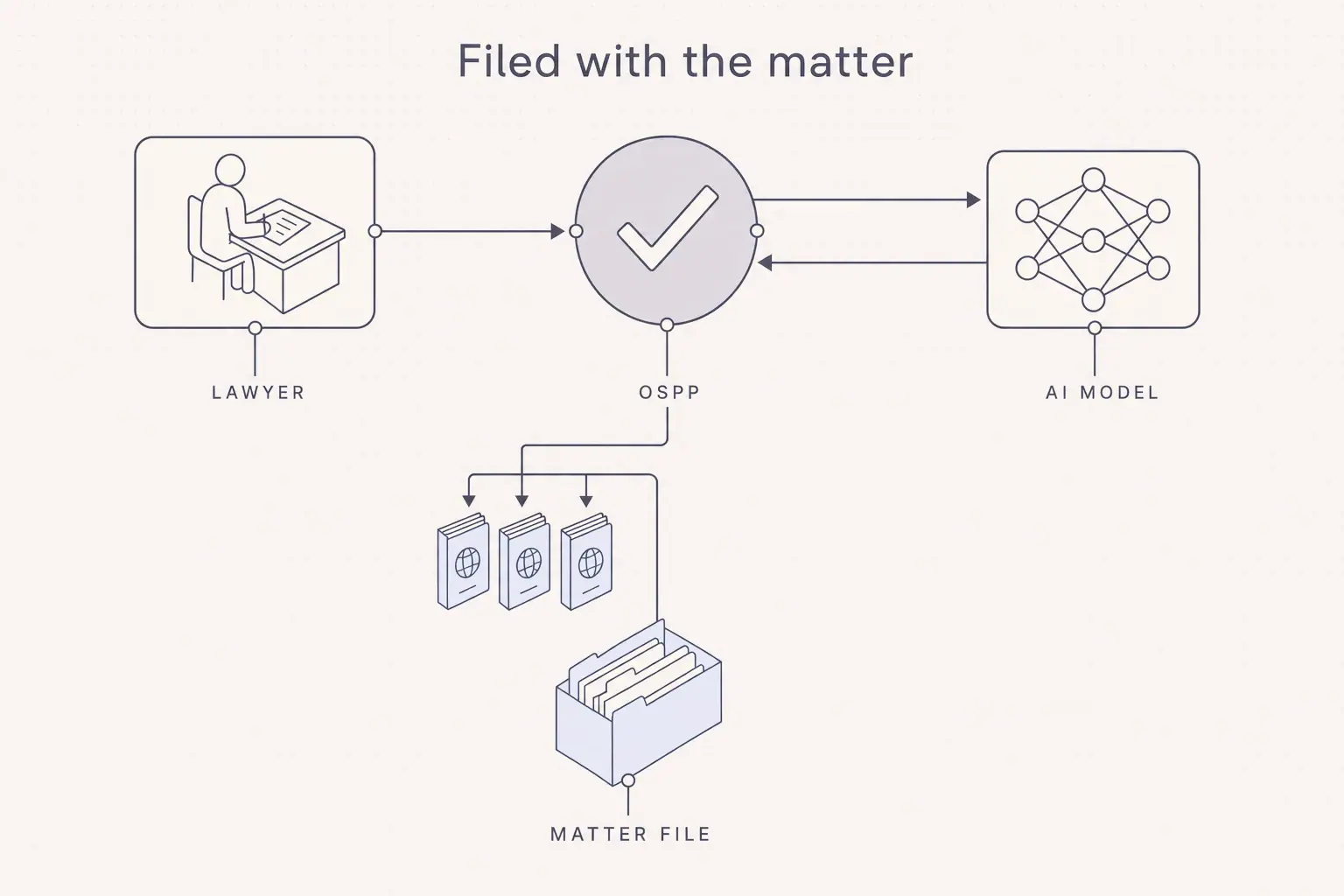
Two labels make the record useful to lawyers.
- The task. A tool names what it is doing, for example
lease-summaryornda-first-review. OSPP calls this a node. The same instructions and the same model make one version of that task, so the firm can say "every lease in this transaction was summarised under the same instructions" and show it. - The matter. A call can carry the firm's own reference, such as the matter number, and passports can be found by it later. The reference is the firm's identifier, not a place for names or secrets.
Witnessed, not read: peer-to-peer validation#
A record a firm makes about itself is an assertion. Lawyers know what turns an assertion into evidence: a witness who has no stake in it. A will is attested by people who watched it being signed. A notary certifies that a signature was made, by this person, on this day. Neither needs to read the document to do their job.
OSPP builds that into every call and calls it peer-to-peer validation. Every organisation on OSPP has a validator. Before a passport is issued, validators that did not make the call check the record of it: that the request was logged before the model answered and the answer after, that nothing in the log was removed, reordered or rewritten, and that the entries follow the published rules. Then they cosign. Without those cosignatures no passport is issued, and a call with an open finding is held until it is resolved.
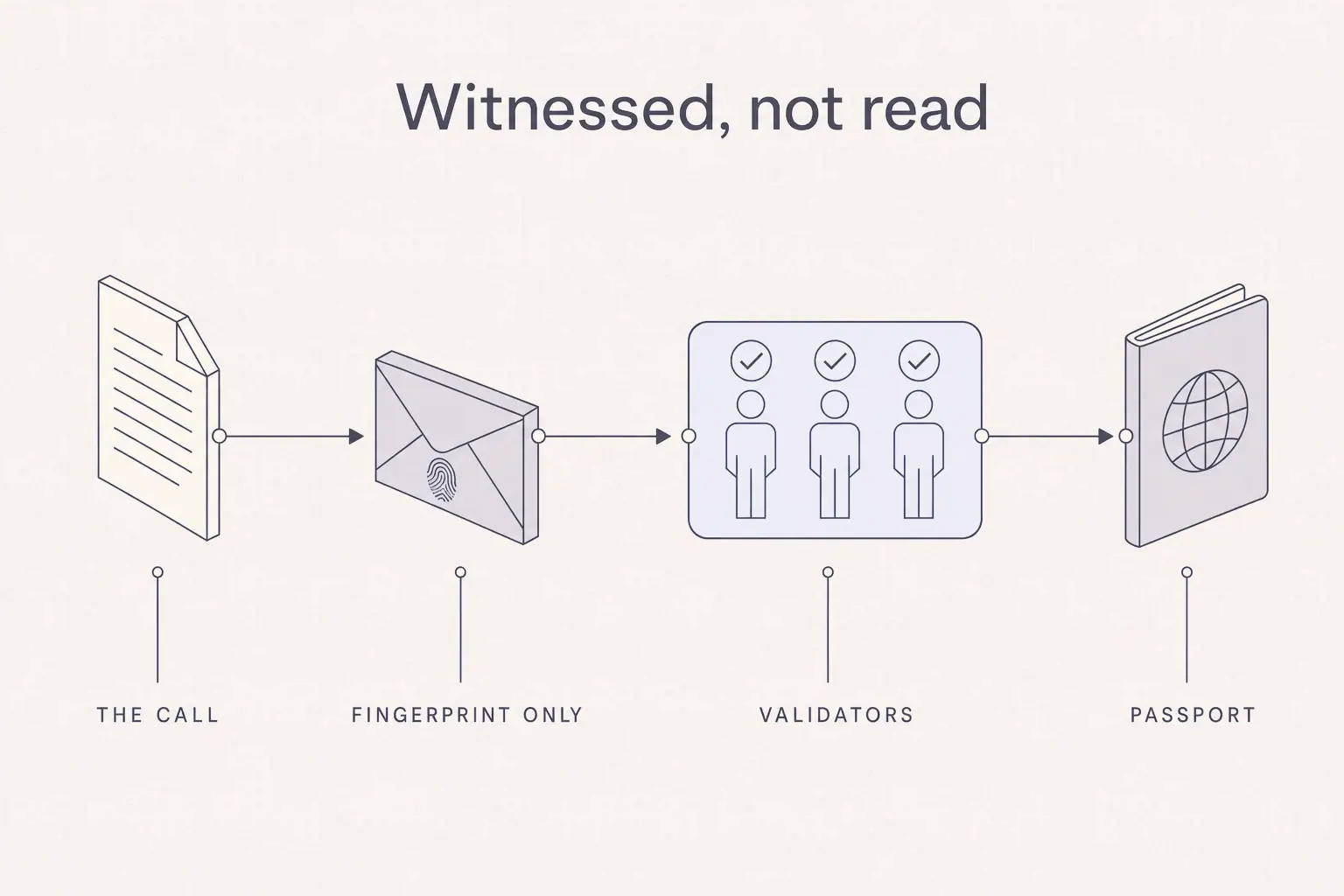
Three properties matter to a firm.
- Privilege and confidentiality are untouched. Validators see fingerprints only, never a prompt or an answer. A client's documents are witnessed without being disclosed to the witnesses.
- No party certifies itself. The firm cannot validate its own calls alone, and neither can OSPP. That is why the record is hard to alter afterwards for anyone, including the firm under pressure and OSPP itself.
- The witnesses are known and accountable. A validator that cosigns a faulty record, or misses a planted test, earns a strike and is suspended after three. The network's public page names the witnesses and the party that runs each. A firm with a self-hosted installation runs its own validator on its own server and becomes one of those peers.
So when a passport is put in front of a client, a court or an insurer, the firm is not saying "trust our log". It is producing a record that parties outside the firm attested at the time.
Where the record earns its keep#
1. Confidentiality: checked before it leaves#
The first duty comes first. Before a call leaves for a model, OSPP's gateway checks what is being sent: personal data, financial and identity numbers, secrets such as passwords and keys, and the special categories the GDPR protects most, including health data and criminal records. The firm sets a policy per task: a finding is flagged, masked (on OSPP Cloud) or blocks the call. The passport carries the result, as counts and never as text.
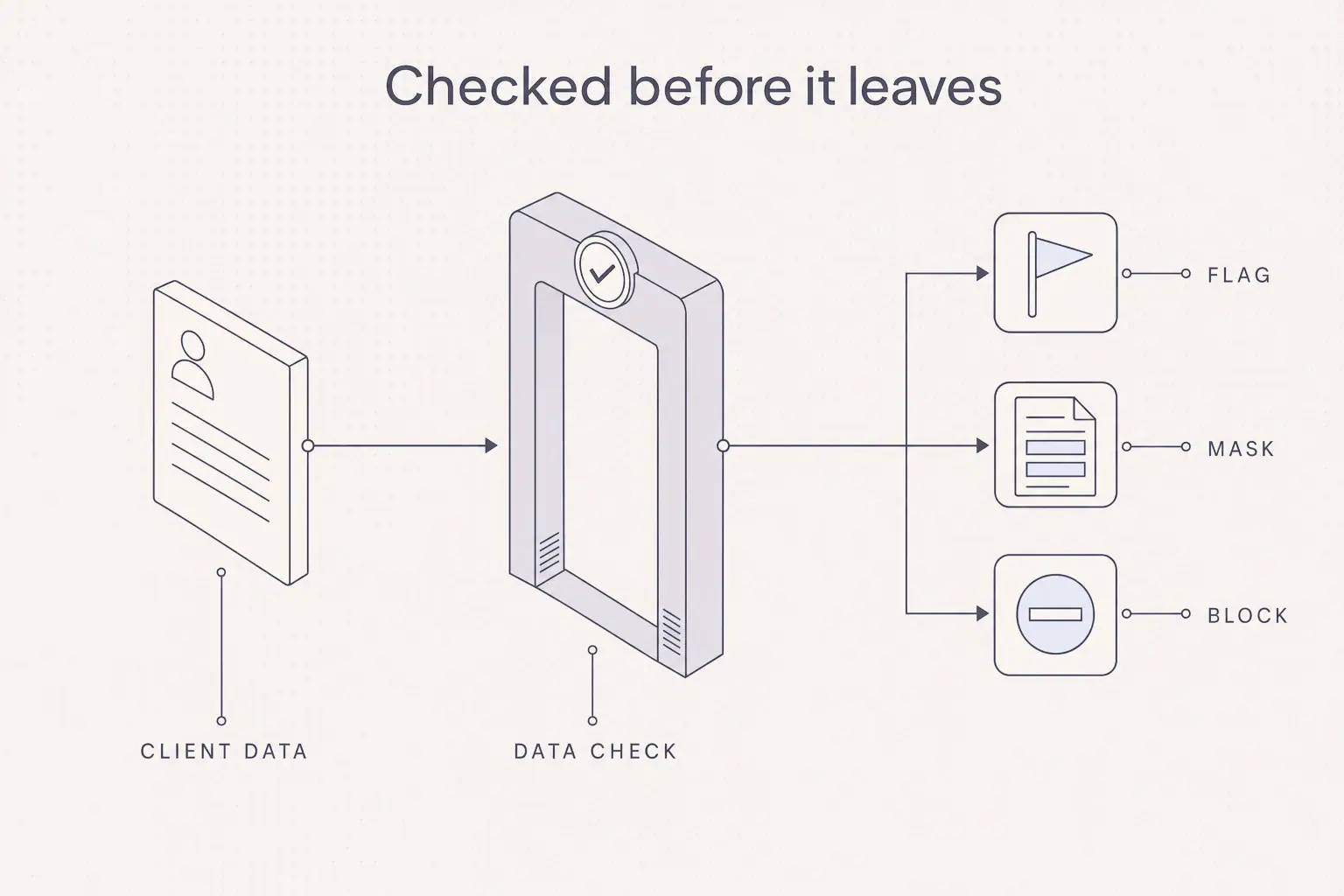
Two further choices matter to a firm.
What is kept. By default, on OSPP Cloud, the conversation and the answer of a call are deleted shortly after the answer is delivered, within about an hour. The fingerprints and the passport stay. What OSPP always keeps is the task's definition: the model, the parameters, the system prompt and the tool definitions. So instructions belong in the system prompt and client material belongs in the conversation.
Where it runs. With a self-hosted gateway, on an ordinary server in the firm's own environment and with the firm's own provider keys, the conversation and the answer never reach OSPP in readable form. OSPP sees fingerprints and figures. The model provider the firm chose still receives the request, as it would without OSPP; that choice stays with the firm.
2. Client disclosure: an AI use statement instead of a paragraph#
Outside counsel guidelines increasingly ask firms to disclose AI use, and many name a human reviewer. The usual answer is a paragraph in the engagement letter. It is sincere, and nobody can check it.
An AI use statement is the checkable version. For one piece of work, the firm lists the AI calls behind it, each with its passport and a note on what the call contributed, and names the people who reviewed the result with their role. The statement can name the exact delivered file by its fingerprint, computed in the browser, so the document itself is never uploaded. Once issued, the statement has a fixed hash and cannot be changed, only withdrawn with a reason.
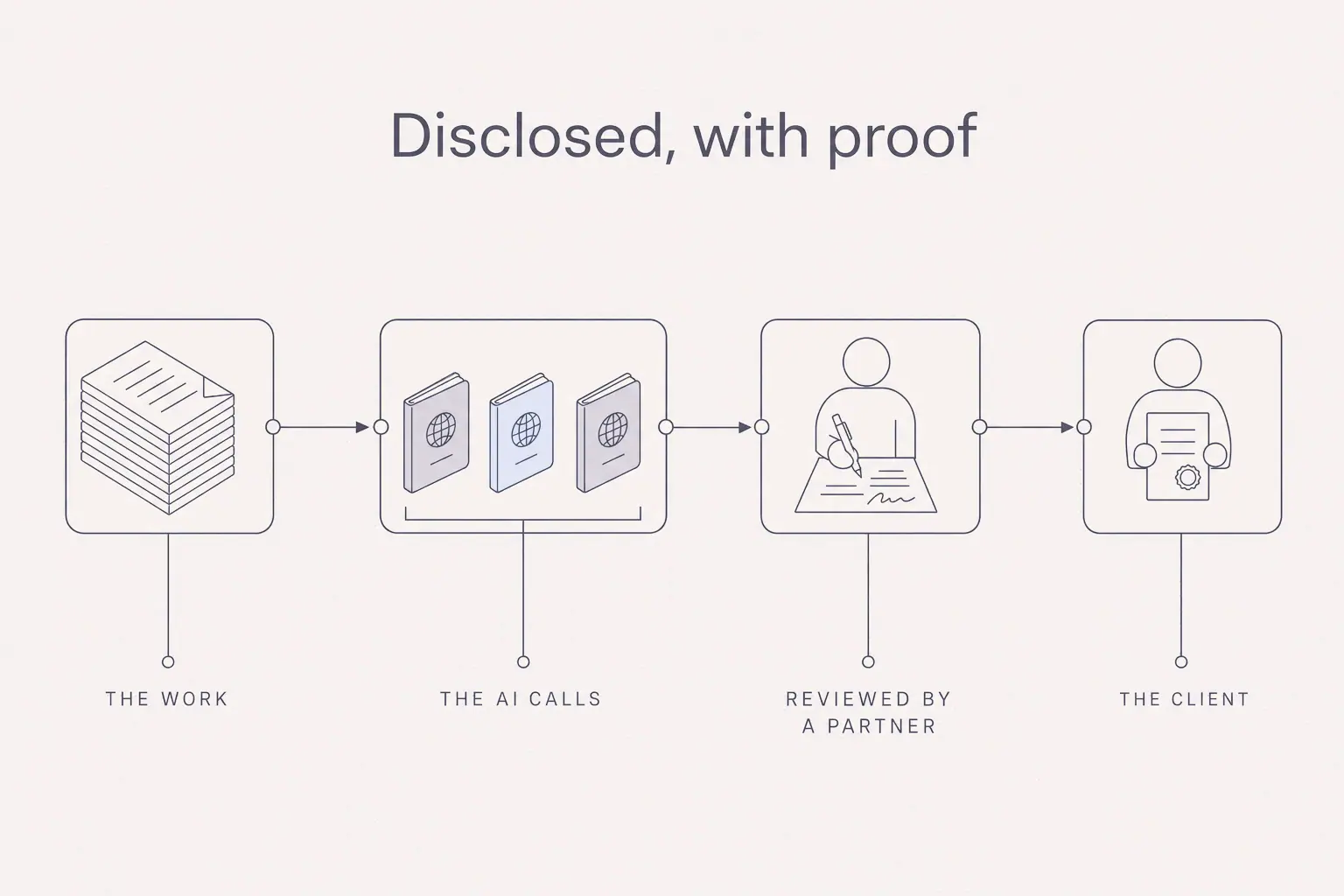
The client receives a link or a PDF, and can verify every passport on it in their own browser. The statement is the firm's own declaration, and its page says so: OSPP signs the passports, and does not check the deliverable, the reviewers or that the list is complete. What changes is that the firm's declaration now rests on records that peer validators witnessed at the time.
3. Supervision: knowing what the firm's AI is doing#
A partner is responsible for work done under their supervision, and a firm for the tools its people use. With every call recorded the same way, the Platform shows per task and per model how many calls were made, what they cost, how fast they were and how often they failed. The data check adds a picture of what kinds of sensitive data went towards a model.
Tools can also report an outcome against a passport, for instance whether a reviewing lawyer accepted a summary as drafted or rewrote it. Over a few months that becomes the firm's own evidence of where AI helps and where it wastes senior time.
4. Disputes and inquiries: when someone asks under pressure#
Sooner or later a question about AI use arrives with a deadline attached: from a court that requires disclosure of AI use in filings, from a regulator, from a client in a fee dispute, from a professional indemnity insurer after a claim.
Passports and their log entries are never deleted, and each was cosigned by validators outside the firm when it was made, so the fact of each call, its date, its model and its fingerprints remain and cannot be revised to suit the dispute. If the firm kept the text of a prompt and an answer, their fingerprints either match the passport or they do not; there is nothing to argue about. With the Compliance add-on, the firm can place a legal hold on a passport, on a statement and every passport in it, or on a version of a task when a dispute starts, so that content still held is not deleted while the hold stands.
One caution belongs here. A passport does not check citations. If a model invents a case, the passport will faithfully record that the model was called and what the fingerprint of its answer was. Reading the authorities remains the lawyer's job. What the record adds is that afterwards nobody has to guess which tool produced the passage, or when.
5. Large reviews: the same instructions for every document#
In due diligence or disclosure, the defensibility of a review rests on consistency. Each document passing through a review task has its own passport naming the task version, so the firm can show that document nine thousand was handled under the same instructions as document one.
There is a subtler risk: the model itself changing mid-review while keeping its name. Model watch probes every model in use with a fixed set of questions and opens a new epoch when its behaviour changes; the epoch is stamped on every passport. If a change falls in the middle of a review, the firm knows which documents were processed before and after. A replay runs a past call again and reports whether the answer came out identical, slightly different or changed, each replay with a passport of its own.
6. Work that arrives from others#
Firms also receive AI-assisted work: from e-discovery vendors, from experts, from co-counsel, from the client's own legal operations team. If it comes with OSPP passports, the firm can paste up to two hundred of them into the verification page, without an account, and learn that the calls exist, when they were made, with which model and by which operator, and that none has been withdrawn. It does not learn what the prompts were, or whether the answers were good. That is the right amount to learn before relying on someone else's process.
The same applies when buying legal technology. A vendor that runs its product through OSPP can hand over a passport with every result. A security questionnaire answered with records carries more weight than one answered with adjectives.
7. Insurers, audits and the management board#
For a task the firm depends on, an assurance profile puts its track record into one document for a buyer, an auditor or an insurer. An evidence pack bundles a period's passports, with their offline proofs, into one file whose hash OSPP registers; whoever holds a copy can confirm it is the original. Both are part of the Compliance add-on. A controls table, on every plan, maps what OSPP records to the EU AI Act, ISO/IEC 42001 and audit-trail guidance, and says for each row what is recorded and what remains the firm's own part. It is evidence for the firm's compliance work; it does not replace a conformity assessment.
8. Choosing models on the firm's own work#
Legal benchmarks are few, and none is made of your documents. For tasks where the firm chooses to keep call content, the Model Arena runs its own past calls again on other models and puts cost, speed, reliability and consistency side by side. It names no winner and it does not judge the answers; a lawyer does that. But it turns "should we move this task to the cheaper model?" from a debate into a comparison.
Starting with one task#
A firm does not need a programme to begin. Choose one task where the question is already being asked, such as first-pass contract review for one practice group. Point the tool at OSPP, name the task, send the matter number as the reference, and look at the first passports with the partner and the risk team.
The free plan covers 25 executions with every feature switched on and no card. The quick start takes about five minutes, AI use statements are described in the documentation, and firms that want content to stay in their own environment can run the same endpoint on a self-hosted gateway. The trust model describes peer-to-peer validation in full.